
The Art of “Maybe”
When we examine the importance of FACE, or 面子 (Miànzǐ), in China’s Face-driven culture, we discover that it permeates all Guanxi-dependent networks, but most of us interpret superficial niceties as a disingenuous way of communicating rather than a purpose-driven necessity that can be incorporated into any winning China strategy.
It’s well known that our (Western) direct communication style may unintentionally offend our Chinese counterparts, whereas more direct transparency is preferred in corporate America, and this contrast is where the rubber meets the road in China.
An outside observer might wonder why these charades are necessary, but seasoned China veterans know the long-term benefits of these rituals for both relationships and the outcomes they seek. For both casual and serious Chinese language learners, we can upgrade our cross-cultural communication toolkit by examining different ways to say “No” and alternative ways to disagree.
Begin by asking yourself…
Do you celebrate your direct communication style because it has worked for you in the past, or will you adjust your approach because the “When in Rome” mantra applies to your journey into China? Are you ready to embrace an alternative way of communicating because you accept that a mindset shift is the surest pathway to true immersion into Chinese culture?
Since you are here, let’s explore how to express disagreement in Mandarin Chinese “when in China.”
The simplest substitute for saying “No” is “maybe.”
You’ve probably been on the other side of a “maybe” response when you asked a “Yes” or “No” question, leaving you frustrated at not getting a direct answer. What you probably missed is that, in the lexicon of spoken Chinese, the “maybe” you heard already tells you everything you need to know and can expect moving forward. And this is the first mindset adjustment in my Pragmatic Face Checklist: Practice being Intentionally Vague (Their Thinking, Page 8).
Now, it’s time to role-play some common Chinese conversations. The six phrases we will review will bring intentional vagueness into focus, not as something to memorize, but as exercises to elevate your China game. Each phrase is a substitute for a common direct response. Study these phrases, learn the cultural context, and practice speaking them purposefully, then naturally.
Chinese Phrases: Intentional Vagueness in Practice
1. 也许 (yěxǔ) — “Perhaps” / “Maybe”
Situation: Your Chinese partner is pushing for a commitment to something you don’t think is viable. The details are fuzzy at best, and you have serious concerns.
Western instinct:
- Direct: “No, we couldn’t possibly agree to those terms.”
- Softer: “Well, probably not because this would be impossible to get approval from corporate.”
- Softest: “I’m not sure this is the right direction — can you walk me through the details?”
Notice all the negative words spoken, even in the softest language, that reflect your emotional and psychological resistance.
In Mandarin:
- 也许我们可以找到一个好的解决方案 (Yěxǔ wǒmen kěyǐ zhǎodào yīgè hǎo de jiějué fāng’àn) — “Perhaps we can discovery a good solution (a way forward).”
In this response, 也许 is a pivot phrase that keeps the conversation moving in a positive direction without making any commitments. It signals goodwill, protects your counterpart’s Face, and leaves your position open. This is a “non-answer” that exemplifies the vagueness approach preferred by your counterparts in China. Literally, you are speaking without saying anything, but you are conveying that more negotiations are needed before anything can proceed.
2. 可能不太方便 (kěnéng bù tài fāngbiàn) — “It might not be very convenient”
Situation: Your counterpart in China makes an unreasonable request that you feel is unethical, but a flat refusal might cause friction and embarrass the person who suggested it.
Western instinct:
- Direct: “No. I am against working this way, and we have policies against this type of behavior.”
- Softer: “We wouldn’t be able to do that. Can you try coming up with something else?”
- Softest: “I’m not sure we can accommodate your suggestion because this might violate our corporate policies.”
Again, recognize all the negative words used, even in the softest language, that reflect your emotional and psychological resistance.
In Mandarin: 这个条件可能不太方便 (Zhège tiáojiàn kěnéng bù tài fāngbiàn) — “This condition might be a little inconvenient.”
In this response, nothing gets rejected, and it is nothing personal. The relationship isn’t strained, while the boundaries are subtly being established. Instead of saying “No” or rejecting their ask outright, suggesting something as inconvenient, 不太方便, is always more palatable.
3. 让我考虑一下 (ràng wǒ kǎolǜ yīxià) — “Let me think about it”
Situation: Similar to the prior example, your counterpart in China asks for more than you can agree to, and a flat rejection might cause a loss of Face.
Western instinct:
- Direct: “No. That’s way out of my budget.”
- Softer: “I can’t agree to that right now — I’d need to run it by my team first.”
- Softest: “This might not be doable, but let’s see if we can meet somewhere in the middle.”
In Mandarin: 这个方案很有意思,我考虑一下 (Zhège fāng’àn hěn yǒu yìsi, wǒ kǎolǜ yīxià) — “This proposal is very interesting — let me think about it.”
While the sofest example isn’t bad, the Mandarin example leads with a compliment (这个方案很有意思) that serves as a buffer. It creates space in the negotiations and lessens possible tensions. During this pause, you have an opportunity to pivot to something else that might be even more valuable for you. Tactically, it is advantageous to explore multiple factors simultaneously to maintain positive momentum and ultimately secure a better deal. This Chinese practice is a page straight out of the Art of War playbook.
4. 我尽量 (wǒ jǐnliàng) — “I’ll do my best”
Situation: You’re asked to do something uncomfortable, and you’re not confident you can deliver.
Western instinct:
- Direct: “No. I’m sorry, but this isn’t something I can deliver.”
- Softer: “I can’t promise anything — there are too many variables I don’t control yet.”
- Softest: “Well, I don’t think I can, but I’ll check, and let’s see what happens.”
In Mandarin: 我尽量在下周之前给你回复。(Wǒ jǐnliàng zài xià zhōu zhīqián gěi nǐ huífù.) — “I will do my best to get back to you before next week.”
我尽量 sets the tone that you will do your utmost to consider their request. This isn’t deceitful, even if you already know the answer. In Chinese culture, your counterparts will fully understand your dilemma. You aren’t setting false expectations. You are communicating in a style that your counterparts in China will appreciate, allowing Guanxi to continue deepening. 下周之前 translates as “before next week,” but in practice it means “indefinitely.”
5. 这个嘛… (zhège ma…) — “Well, about this…”
Situation: A sensitive topic or request was raised in a group setting — pricing information, exclusivity, or a competitor’s name — that, if divulged, would be ethically or morally wrong.
Western instinct:
- Direct: “No. We couldn’t possibly do that.”
- Softer: “That’s a fair question — let me give you a straight answer on where we stand. This is against our corporate policy.”
- Softest: “Well, I don’t think we can, but I’ll check anyway.”
In Mandarin: 这个嘛,情况比较复杂,我们需要再研究一下。(Zhège ma, qíngkuàng bǐjiào fùzá, wǒmen xūyào zài yánjiū yīxià.) — “Well, this situation is a little complicated — let’s explore it more deeply.”
The pause built into 这个嘛 is not hesitation — it is a signal that you are giving the request serious consideration. Complexity (复杂), expressed in this context as “a little complicated,” is a graceful deflection. Learn the strategy behind this phrase when the answer is “No,” but you want to offer a Face-saving off-ramp.
6. 再说吧 (zài shuō ba) — “Let’s discuss it later”
Situation: Someone raises a politically charged, premature topic likely to cause division, and continuing the discussion might cause embarrassment and possibly derail the wider agenda.
Western approach: “Let’s address this now while everyone is here, since we are all affected.”
- We believe there is value when everyone puts their cards on the table. We value open debate as a means of reconciling differences, which we call “alignment.”
- We believe alignment is best reached via storming, forming, norming, and conforming.
- We believe it’s just business, nothing personal, but in China, everything is personal; alignment is based on the continuous exchange of goodwill a.k.a. Guānxì.
In Mandarin: 这个问题比较敏感,我们以后再说吧。(Zhège wèntí bǐjiào mǐngǎn, wǒmen yǐhòu zài shuō ba.) — “This issue is rather sensitive — let’s talk about it later.”
This might be one of the most misunderstood Chinese colloquial expressions (口头禅 Kǒutóuchán). Literally, it translates as, “let us discuss it later.” Culturally, it means “let’s avoid bringing up this topic again.” The person saying “再说吧” is indicating that he doesn’t want to address this issue, ever.
The Discipline of Saying Less
Most Westerners will need to practice intentional vagueness — it won’t happen naturally. The instinct to clarify, confirm, and close is deeply wired into how we communicate professionally, but in China, that instinct routinely works against us.
Think of these phrases as precision instruments, not workarounds. Each one gives you control over the mood of a conversation — cooling tension, buying time, or declining without hurting someone’s feelings. China veterans who build durable relationships and get things done aren’t the ones who found a way around directness. They’re the ones who mastered the alternative.
Ready to Go Deeper?
The phrases in this post are just the beginning. If you’re serious about communicating effectively in China, the mindset shift behind these words matters as much as the words themselves.
Download the free 23-page guide — Chinese Thinking: Three Levers to POSITIVELY Influence Behavior in China — and get the Pragmatic Face Checklist referenced in this post.
Send Me the Free Guide →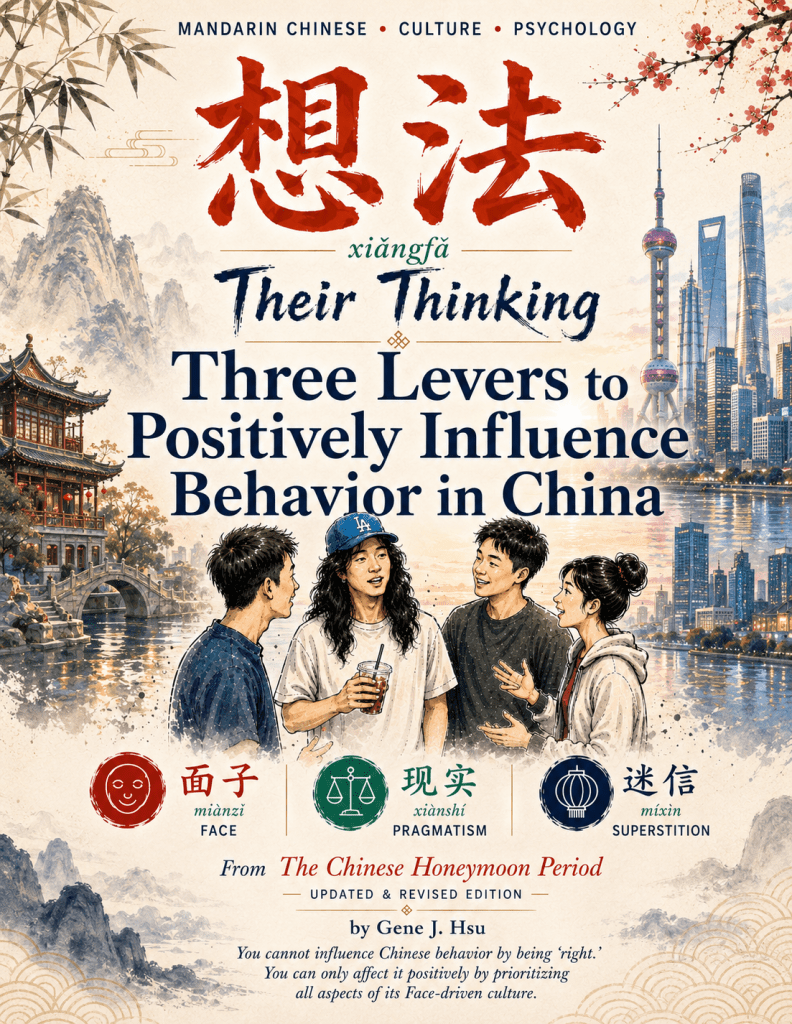


Leave a Reply