
Understanding HOW YOU SHOULD RESPOND
“Giving Face doesn’t mean abandoning your values. It means choosing where—and how—to express them.”
By now, one illusion should be gone. Chinese thinking does not conform to our Western values, expectations, and processes.
From Chapter 4 of The Chinese Honeymoon Period, you understand that in China, trust does not guarantee truth.
Truth is conditional.
Responses are ritualized, and Harmony outranks morality.
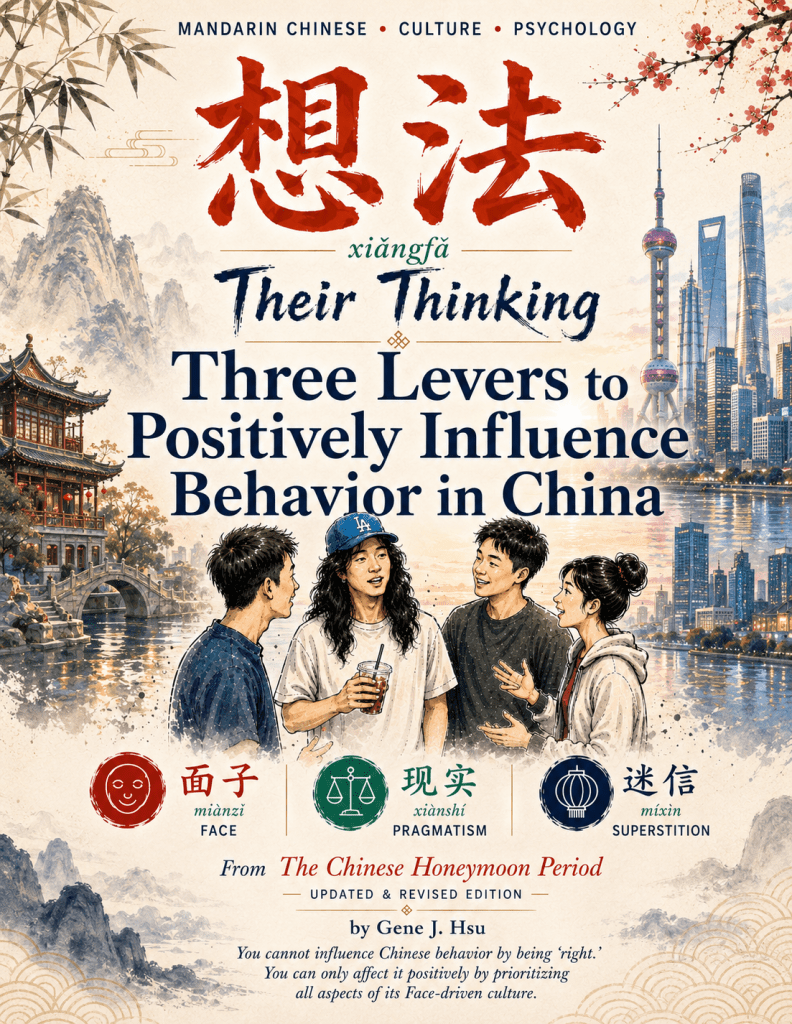
In Chapter 5, Giving Face (给面子 gěimiànzǐ), we confront the moment our new enlightenment begins to cause discomfort.
How do we give Face when this very gesture collides with our Western sense of ethics, honesty, and personal integrity?
In other words, 如何用不同的方法看同样的事情 (rúhé yòng bùtóng de fāngfǎ kàn tóngyàng de shìqíng)?
It’s a rhetorical question. 这是一个反问句 (zhè shì yīgè fǎnwèn jù)?
How do we learn to view situations from an alternative perspective, one that conforms with the environment we are attempting to enter, enjoy, or exploit?
The Western Ethical Trap
“Western cultures tend to view ethics through a narrow lens of righteousness.”
If something feels dishonest, we feel compelled to challenge it. But in China, truth is relative.
Silence feels like complicity.
Ambiguity feels deceitful.
So when foreigners in China encounter vague answers, indirect communications, and Face-saving behaviors, internal frustrations begin to simmer:
- Am I complicit in rewarding dishonesty?
- Am I compromising my own values?
- How can I make a decision without all the facts?
But this framing collapses inside the Chinese arena.
Why?
Because giving Face is not deception. It is the lubricant that keeps the Guānxì engine running, and by now, we all know how overwhelmingly essential this is to thriving in China.

What Giving Face Actually Means
First, the mindset adjustment. Giving Face does not mean:
- Lying
- Condoning bad behavior
- Endorsing wrongdoing
- Abandoning your ethics and values
It means choosing not to impose your moral certainty because it would cause unwarranted harm, and consciously choosing long-term success over emotional gratification.
In Chinese psychology, ethics are contextual and relational, where the higher moral duty is to prevent harm and preserve harmony rather than to establish absolute truths.
In this regard:
- Silence is honorable
- Vagueness is pragmatic
- Lying is Face-giving
- Deflection is Face-preserving
You are not being asked to condone bad behavior.
You are being asked to avoid humiliation, escalation, and irreversible loss of trust.
Don’t sabotage your Guānxì relationships unnecessarily!
How to Respond Without Losing Integrity
Finding your ethical footing in China starts with rethinking your moral convictions in the proper cultural context. Here are a few simple practices you can start folding into your everyday persona.
- Respond indirectly when your question isn’t answered properly.
- Ask nonsensical questions to offer a Face-preserving offramp.
- Align on process according to Chinese rituals, not the specifics you crave.
- Observe actions rather than responses as a better predictor of outcomes. In China, the literal words do not matter.
Remember, in the Chinese arena, being “right” carries negative connotations. It’s human psychology. But you always acquire positive influence in China by keeping your Guānxì engine running smoothly.
Where We Go Next
If Chapter 5 reframes ethics and Face, the next chapter addresses some of its origins, the Iron Rice Bowl mentality.
China has reached parity with the US, and its economy has climbed to #2.
Chapter 6 looks at whether China’s Iron Rice Bowl mentality still lingers today, how to recognize its traces, and how it shapes negotiations, communication, and leadership.
If this reflection challenged how you think about ethics, truth, and communication across cultures, Speak Less, Guanxi More takes these ideas one step further—into practice.
The book isn’t about memorizing cultural rules.
It’s about learning when not to speak, how to read what’s really happening beneath the surface, and how trust and leverage actually form inside the Chinese arena.
Speak Less. Observe More. Understand Deeper.



Leave a Reply