Tag: Speak Chinese
-

Interpreting Chinese Attitudes In Our Reflections | Xīntài (心态)
Western professionals often misinterpret Chinese behavior because they project their own emotional assumptions onto it. In Chapter 8, we explore Xīntài (心态)—a concept deeper than “attitude”—and uncover how emotions like Wěiqu (委屈) and Jiāolǜ (焦虑) quietly shape decision-making, trust, and reactions to pressure inside the Chinese arena.
-
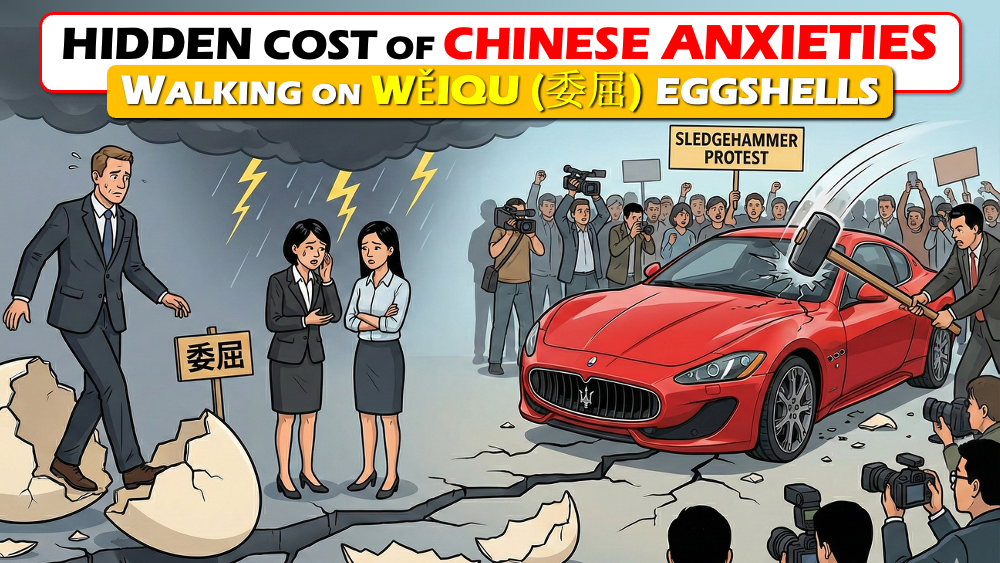
Walking on Wěiqu (委屈) Eggshells: The Hidden Cost of Chinese Anxieties (焦虑 Jiāolǜ)
Pressure doesn’t motivate people in China the way Western leaders expect—it often creates invisible emotional fractures. In Chapter 7, we explore two powerful Chinese emotions that don’t fully translate into English: Wěiqu (委屈) and Jiāolǜ (焦虑). When feelings of being wronged are swallowed to preserve Face, they don’t disappear—they accumulate. And when suppressed long enough,…
-

Giving Face Without Losing Yourself: The Real Ethical Test in China
In China, Giving Face doesn’t mean abandoning your values—it means choosing when and how to express them. This chapter explores why trust does not guarantee truth, why harmony often outranks moral certainty, and how Western instincts around honesty can quietly sabotage guānxì. If you’ve ever felt ethically uncomfortable navigating Chinese relationships, this reflection reframes what…
-

Decoding Chinese Behavior Based on Their Internal Lìyì (利益) Calculus
Chinese behavior isn’t guided by what feels fair — it’s guided by what feels beneficial. To understand how decisions are really made, you must grasp Lìyì (利益): a perceived, personal benefit calculus shaped by pragmatism, guanxi, and evolving relationships. Until you see the world through this lens, Chinese actions may seem inconsistent — but once…
-

The Secret Behind “China Speed”: How a Volleyball Strategy Became a Business Mindset
Most people explain “China speed” with economics or policy. But its roots lie in something far more surprising: a volleyball strategy from the 1980s. This article uncovers how 短、平、快 — short, flat, fast — evolved from athletic brilliance into the mindset driving China’s modern business success.
-

Is Guānxì Enough? Unveiling the Hidden Dynamics of Chinese Relationships & Power
Understanding HOW THEY OPERATE “Try to imagine what people might think or do behind the scenes when you are not around, if you are perceived both as unqualified and a threat to their well-being.” You think you finally understand China. You’ve cracked the code — or at least you think you have. You’ve built the…
-

Why your Mandarin fluency is irrelevant
Fluency in Mandarin doesn’t guarantee understanding in China. In fact, it can work against you if you don’t recognize how you’re perceived. As Gene J. Hsu explains, communication success depends more on cultural awareness, psychology, and perception management than on perfect pronunciation or vocabulary.