
Understanding WHAT THEY MEAN
“Trust does not automatically mean you’ll get the truth — because in China, truth is relative.”
Interpersonal communications broadly operate under the assumption of Truth-Default, a concept developed by Distinguished Professor and Chair of Communication Studies at the University of Oklahoma, Timothy R. Levine, author of the book Duped. It assumes that most people are mostly honest most of the time, and in Western cultures, this is the foundation for building trust and getting the truth.
Psychologically, Chinese communication norms don’t follow the same default-to-truth when talking to strangers. Instead, Chinese people will naturally default-to-skepticism, even with other Chinese people. Ironically, Chinese people will tend to “trust” a Western stranger more than an unfamiliar Chinese person, not because they believe Westerners are good people.
It’s because they believe Westerners are naïve and lack pragmatic common sense. In other words, they will choose what to say based on principles rather than benefit.
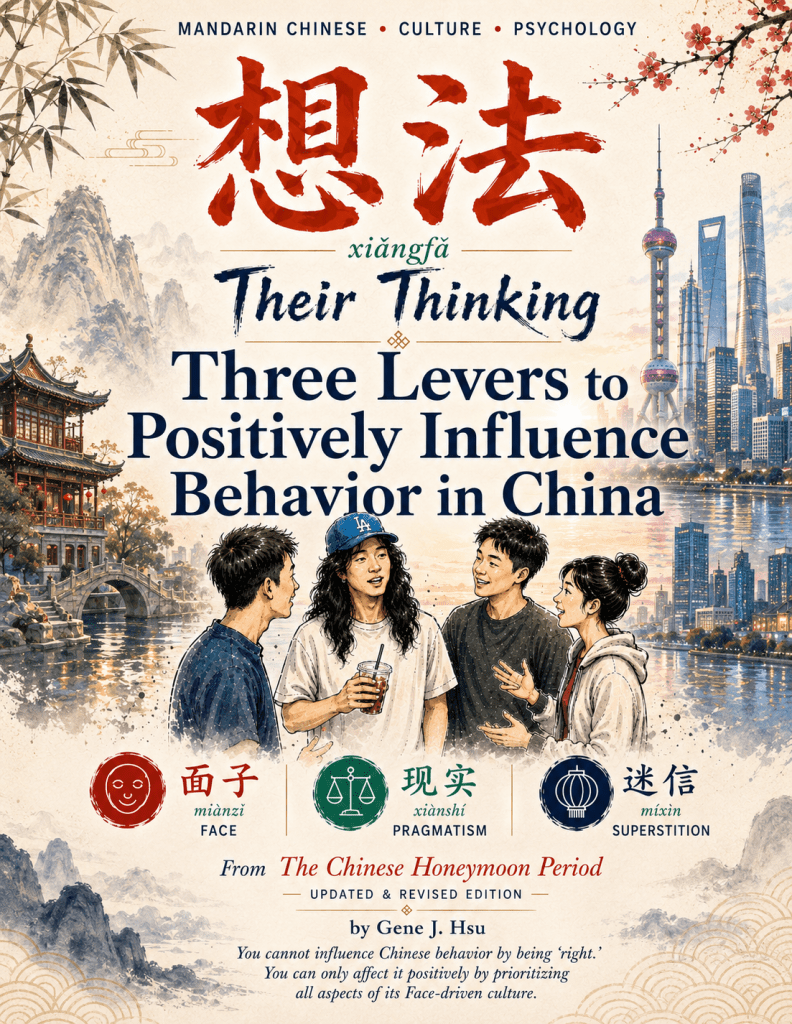
Chapter 4 of The Chinese Honeymoon Period untangles one of the most detrimental assumptions that foreigners bring to China — the belief that trust and truthfulness are correlated and tied to ethics and morality that all people “should” share.
They aren’t, it isn’t, and we should not judge.
In China, trust is relational, while truth is conditional.

The Trust–Truth Dichotomy
Foreigners often assume that once Guānxì deepens, honesty naturally follows. Dinners become frequent. Conversations feel warmer. Favors are exchanged. Surely, you can now expect answers to be more truthful.
But in Chinese psychology, trust does not mean “I will tell you the truth.”
It means, “I will treat you more favorably, and expect you will reciprocate.”
In Western terms, greater truthfulness should occur when emotional safety is high and potential consequences are removed: “Don’t worry, you can tell me the truth.”
But in reality, paradoxically, the “absolute, literal truth,” especially regarding one’s feelings, will remain elusive, and perhaps more so as Guānxì deepens. Western literal and absolute truths carry psychological liabilities inside the Chinese arena.
For example, a Chinese wife and husband have the deepest level of Guānxì. The wife asks the husband whether the food she prepared is delicious (好不好吃?). The Chinese husband will always answer in the affirmative. He will say, “好吃,” meaning delicious, but he isn’t referencing the literal taste of the food. Instead, the husband is acknowledging a wife’s traditional obligation because, subconsciously, he wants it to continue, even though in modern China she no longer has to follow those traditions. By contrast, an American husband sees the query as an opportunity to order what he prefers for the next meal. He tells the truth. The Chinese husband practices a ritual and prioritizes harmony.
Why Seeking The Truth In China Is Dangerous
In Western culture, truth is virtuous.
In Chinese culture, the real truth is destabilizing.
Typically, when a Chinese person asks a question, they are seeking affirmation rather than feedback or suggestions, so a “truthful” response might cause embarrassment or loss of Face. The “literal” truth might also expose internal conflicts, impose an unnecessary burden, or be interpreted as assigning blame. This is why a casual inquiry can lead to a circular conversation that escalates into disagreement and conflict.
So the art of rhetorical communication, necessary to simplify conversations in China, intentionally uses vague language, while displaying a lack of awareness and a sense of cluelessness — not to mislead or obfuscate, but to preserve harmony while abdicating responsibility.
This should explain why pressing for clarity often backfires in China. This posture is also self-defeating because demanding the “truth” increases the pressure to mislead.
Features Of Chinese Communication Styles
Chinese responses do not reflect opinions or true feelings in the Western sense that we seek these insights. Instead, we would be better served to interpret them as rituals, choreographed responses designed to give Face and extend goodwill based on the level of Guānxì (Chapter 1) and potential Lìyì (Chapter 2).
A pause means, “I don’t feel it is safe yet.”
A vague acknowledgment means, “I am preserving my flexibility to pivot.”
A polite deflection means, “I am conditioned to allow you to preserve face.”
If you treat these as communication features, you will be able to discern the unspoken truth that actually matters, rather than the absolute truth that lacks any positive significance.
Where Chapter 5 Goes Next
If Chapter 4 explains why trust does not equal truth, Chapter 5 tackles the harder problem:
Giving Face in light of your moral and ethical dilemmas.
Because in China, truth doesn’t emerge by default.
It emerges when the environment allows it to thrive, or when you learn how to read between the lines colored in many different shades of gray.
That’s the skill most foreigners never learn — and exactly where we go next.
If this article challenged how you think about trust, truth, and human behavior across cultures, Speak Less, Guanxi More takes that awareness one step further—into practice.
The book isn’t about memorizing cultural facts or learning what to say in China. It’s about learning when not to speak, how to read what’s really happening beneath the surface, and how relationships, trust, and leverage actually form inside the Chinese arena.
If you’ve ever felt that Western logic explained China poorly—or that global metrics miss what truly matters—this book was written for you.
Speak Less. Observe More. Understand Deeper.
Speak Less, Guanxi More is available now for readers who want fewer assumptions—and far better outcomes.



Leave a Reply