
What’s the human psychology of the idiom “happy wife, happy life?”
Why do we so easily accept its wisdom and put our egos aside when disagreements arise?
And how can we apply this mindset to our partnerships in China?
Let’s open our imaginations, study some Chinese phrases in the proper cultural context, and explore what attitude and mindset adjustments will lead to a more rewarding experience in China.
Chinese Glossary
红烧鱼 (hóngshāo yú) — braised fish; the centerpiece dish on the family dinner table in this piece.
老婆,辛苦了,好好吃 (lǎopó, xīnkǔle, hǎo hào chī) — “Honey, you worked so hard. It’s delicious.” The husband’s opening line to his wife, and the piece’s central example of a Face-affirming white lie.
嗯,好吃好吃 (Dzg, hào chī hào chī) — “Yeah, it’s so delicious.” The son’s echo of his father’s line — a small, learned ritual of family harmony passed down before he’s old enough to know why.
错解 (cuò jiě) — misinterpretation; the mistake a Western observer makes when reading the husband’s two different comments as a contradiction rather than two appropriate responses inside two different rooms.
关系 / Guanxi (guānxi) — the web of relationships and reciprocal obligations that arrange Chinese social and business realities; what well-placed white lies are silently developing.
入乡随俗 (rùxiāngsuísú) — “when in Rome,” or more literally, “enter the village, follow the customs.” The attitude adjustment this piece asks Western readers to make.
面子 / Face (miànzi) — the social standing and dignity a person maintains in front of others; what the husband’s praise is protecting and building, both at home and at the bar.
算旧账 (suàn jiùzhàng) — to dredge up old, long-buried emotional grievances; the negative spiral a well-timed white lie is specifically designed to avoid.
善意的谎言 (shànyì de huǎngán) — literally “a lie of good will,” or “well-intentioned lie”; the Chinese term for exactly what Westerners already call a white lie, and the phrase that captures the mindset of this lesson.
用不同的方法看同样的事情 (yòng bùtóng de fāngfǎ kàn tóngyàng de shìqíng) — “use a different perspective to view the same thing”; the fundamental mindset shift needed to reimagine China in order to create a new reality — no new facts, just a new lens.
Two Rooms, Two Stories
At home, his wife has been preparing and cooking all day — braised fish (红烧鱼 hóngshāo yú), a variety of vegetables, shrimp, a table full of dishes made from scratch. The husband looks at her fondly and says, “老婆, 辛苦了, 好好吃.” (lǎopó, xīnkǔle, hǎo hào chī.) “Honey, you worked so hard. It’s delicious.” His son adds, “嗯, 好吃好吃” (Dzg, hào chī hào chī) — “Yeah, it’s so delicious” — it’s what daddy reminded him to say when mommy was still in the kitchen.

In today’s China, one might say, 弄好老婆,天下太平 (hǒng hǎo lǎopó, tiānxià tàipíng) — “Keep the wife pleased, and the world stays peaceful.” Humorous and meme-like.
More traditionally, 家和万事兴 (jiā hé wàn shì xīng) — “When the family is harmonious, everything prospers.”
Later that evening, the man is at a bar with an old friend, beer in hand, burgers and nachos on the table, with live rock’n’roll music from the house band. His friend asks, “Did you eat yet?” He grins and says, “Now this is real food.”

In Western thinking, this might seem like a small betrayal — a man openly being dishonest, saying one thing at home to his wife and then expressing his true feelings behind her back. But that misinterpretation (错解 cuò jiě) misses what’s actually happening. The man isn’t lying. He’s doing exactly what he’s supposed to do in two different rooms. — Inside his Chinese reality, he is maintaining harmony starting at home.
In China, context matters.
And what you say will move things forward more than your actions, more than reaching “alignment,” and more than what you can promise.
What Chinese people choose to say depends on the level of Guanxi; sometimes it is based on pragmatism; in the end, for those seeking better fortunes in the Middle Kingdom, we need to adjust our attitudes based on how the local culture works, “when in Rome.” (入乡随俗 rùxiāngsuísú)
Words aren’t for conveying information. They’re used to create harmony.
In Chinese culture, spoken words are less a vehicle for facts and more a tool for managing relationships and emotions. The man telling his wife the food is delicious isn’t making a factual claim to be tested against the burger he’ll eat later—he is simply using words as tools to shape his reality. The man’s praise doesn’t make the fish taste different, but it does transform the experience at home. And for greater cultural context, expressing how the food actually tastes won’t get him a better meal next time; it’s 100% to show appreciation; it is a Face-affirming demonstration.
In fact, praising what you dislike in this situation is more likely to get you rewarded with what you really want to eat the next time. This is Chinese thinking in action, a form of reverse psychology enhanced with emotional liabilities. In America, spouses generally want to know “what you prefer to eat,” so they can prepare it for you next time. In China, enjoying the prepared meal is for your better half who’s been laboring all day in the kitchen, and the dining experience is itself a ritual.
Same setting. Same occasion. Two completely different cultural realities. In the West, the conversation is transactional. In China, the conversation itself is a habit, and Chinese people find comfort within these rituals. It sets the tone for everything.
Perhaps the man never wants fish and vegetables, but by speaking positively, the family meal becomes both delightful and comforting. It’s not that his wife is less likely to deny him a night out afterward. Instead, he reinforces the positive energy within their Guanxi and avoids a petty argument that would likely spiral into an endless debate and dredge up past emotional grievances (算旧账 suàn jiùzhàng) long thought buried.
With those simple words, “老婆,辛苦了,好好吃,” life proceeds; it’s what is expected, and the present doesn’t get dragged into a negative past, leaving the future hopeful.
This is how every relationship in China, business or personal, can be managed in a Chinese cultural context. It’s a microcosm we can study and apply to our interactions in China.
The attitude, mindset, and approach necessary to tell these white lies can be applied to every interaction with someone in China, for any pursuit and endeavor — a better outcome is 100% within our influence after we learn to think differently (用不同的方法看同样的事情 yòng bùtóng de fāngfǎ kàn tóngyàng de shìqíng) — Words are tools that are used to shape reality, not for judging honesty and trustworthiness.
You already believe this, and it has a name
Here’s the thing: Americans already have a name for this mindset and its overarching benefits.
We call it a white lie — and in Western psychology, white lies are generally treated as a good thing, not a moral failure. We all know intuitively that most small deceptions are meant to spare someone’s feelings, smooth over an awkward moment, or to just be a “good friend.” Telling a friend you love their gift or restaurant choice, even when it’s not your cup of tea — we don’t call that dishonesty. We call it tact, kindness, and even political correctness in certain situations. Some might even say it is common sense.
This Chinese term for white lie is 善意的谎言 shànyì de huǎngán — literally, “a lie of good will” or “well-intentioned lie.” Same concept, same moral get-out-of-jail card for not telling the truth. The husband’s “delicious” comment isn’t a factual report on the fish. It was a white lie — a small, deliberate act of kindness wrapped in an expression.
The bottom line
We are all human, and we naturally judge others against unfamiliar habits and rituals. The key to creating a more rewarding experience in China is to imagine your own humanity within their cultural context.
“To be successful in China, you have to manage the different shades of gray because nothing in China is black or white.” — David Chang, China CEO, Philips China (2002–2008)
Ready to go deeper into Chinese Thinking?
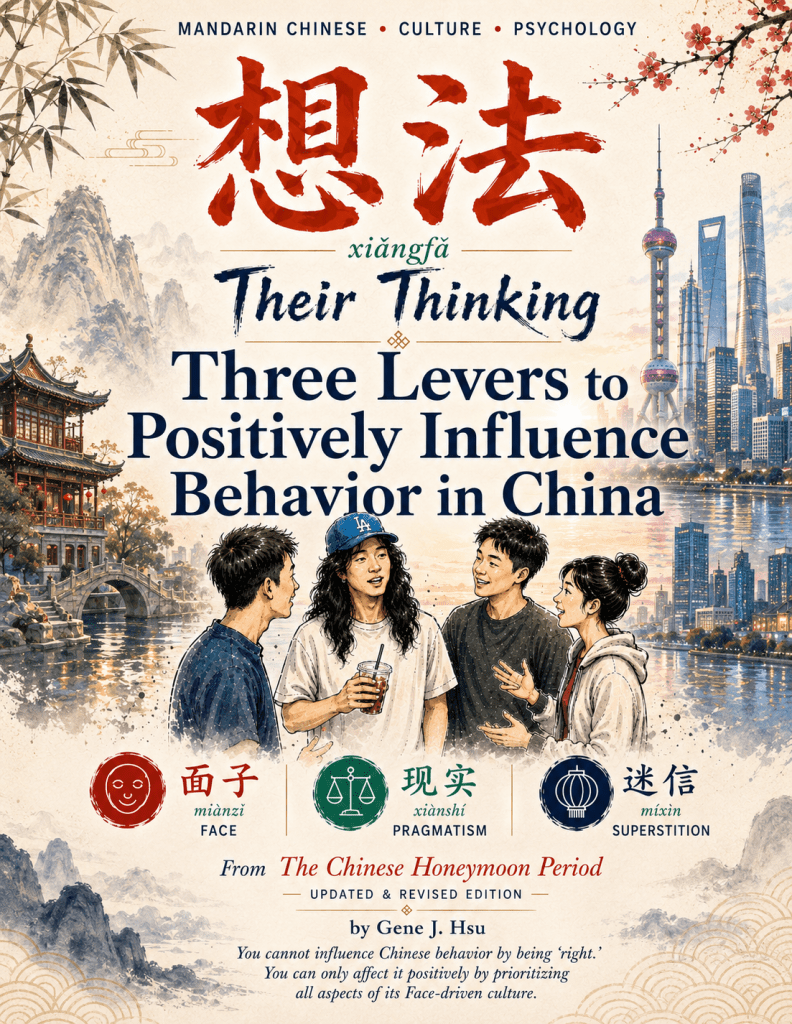
The husband’s comment at home wasn’t accidental — it was part of a Face-Affirming ritual. And Face (面子 miànzǐ) is just one of three psychological levers that quietly governs nearly every emotion you’ll encounter in China, from the dinner table to the negotiation table.




Leave a Reply